Breeder of champion line Selkirk Rexes, the curly cats. We breed both short and long hair versions.



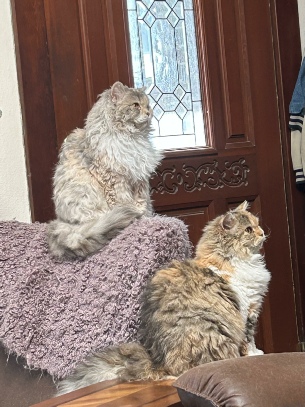
The Selkirk Rex is very relaxed cat that has the look of a stuffed teddy bear, which makes you just want to pick it up and cuddle it. One of the rexed (curly) breeds, they have a tousled look to their hair, which is a dense coat that gives them the appearance of having a bad hair day.
The Selkirk Rex curly coat is produced by a dominant gene affecting the guard, down and awn hairs of the coat. The curl is most prominent around the neck and tail in both coat lengths, short hair and long hair. Guard hairs tend to have a coarse texture, but the coat is very dense and overall soft and plush. The whiskers are curly as are the eyebrows. The coat continues to develop until about 2 years of age, so kittens and young adults should be judged mainly on head and body type. Kittens are curly at birth and may lose their coat and begin to develop an adult curly coat at 8-
The Selkirk Rex is a medium to large cat that is structured with good balance. They have heavy boning which gives the cat surprising weight. Females may be less massive than males but they should not appear dainty. Both males and females will jowls. The Selkirk Rex are known for their placid, cuddly nature, yet are still very active and love to play. They are very social and dislike being left alone for long periods. Keep this fun-
The loving and affectionate Selkirk Rex is a perfect choice for families with children and cat-
HISTORY:
In 1987 a feral blue tortie & white cat in Montana had a strange looking kitten in a litter of 5. At 9 weeks old, this strange kitten was noticed by Jeri Newman, a Persian breeder, who became curious about the kitten’s curly whiskers, brillo-
Miss DePesto’s littermates did not have this unusual coat, but normal hair. Because there were no other curly haired cats in the area, Ms Newman believed she was dealing with a new mutant rex gene and decided to further explore this possibility. When Miss DePesto was 14 months old, she was bred to Ms Newman’s black Persian male CH Photo Finish of Deekay. On July 14, Miss DePesto had a litter of 6 kittens and 3 of those kittens were undoubtedly curly. This suggested that the gene that caused the curly hair in these kittens was dominant, unlike that of the Cornish and Devon Rexes. It also proved that Miss DePesto carried a long hair gene, which is recessive. TICA accepted the Selkirk Rex into the New Breed program in 1990 and recognized it for championship competition in February 1994.
PERSONALITY:
These are loving, patient cats reflecting the temperaments of the breeds used to develop the Selkirk Rex, which are the British Breed Group (British Longhairs and British Shorthairs) and the Persian Breed Group (Persian, Himalayan, and Exotic Shorthair). The British Shorthair and Longhair contributed the laid-
HEALTH:
The Selkirk Rex breed is generally a healthy breed. It is recommended that their vaccinations and parasite treatments are kept to date and that regular veterinary appointments are scheduled.
GROOMING:
Regardless of if you want the short hair or long hair version of the Selkirk Rex, the cat has a dense coat that needs regular but casual attention. It is best to comb the coat a few times a week to prevent tangles and to remove dead hair. Selkirk Rexes do shed and this combing will help reduce residual hair from falling to the carpet and furniture. You can also run your fingers through the hair to fluff up the appearance of their curls.
Bathing a Selkirk Rex is only necessary if it gets dirty or becomes oily to the touch from an accumulation of natural oils. Use a moisturizing shampoo and let them air dry for a few hours in a warm, draft-
Don’t forget to clip nails every few weeks to keep the cat comfortable and prevent the need for the cat to scratch where it shouldn’t. Examine ears for the need to clean them. Teeth should be brushed, and if not, examined yearly by a vet for dental care.
NUTRITION:
Selkirk Rexes do not need any special dietary needs, as a breed. However, cats are carnivorous and need animal proteins to support their health. Do not feed a cat plant protein as a replacement for animal protein. Provide copious fresh, clean water as well.